Endangered Species
13 June – 12 September 1992
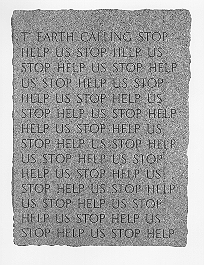
 Yoko Ono, in Germany better known for her marriage to John Lennon, has been continuously active as an artist since the 1950s. As a co-founder of Fluxus and performance art, she enjoys high esteem among her fellow artists, such as John Cage and Wolf Vostell.
To bring this art, which is particularly topical at present, closer to a wider public as well, and to give the artist the recognition she deserves, the Stiftung Starke decided on this exhibition.
Several sources of financial support were secured from private industry for this exhibition, so that a poster, the posting of the poster, an invitation card and transport could be financed. The extensive advertising had the advantage that visitors were recorded not only at the opening but also during normal opening hours.
The artists living in the house at the time benefited particularly. Visitors were encouraged to visit the studios, and so the artists had the opportunity to show their work to a number of interested people.
The seismographic instinct that Yoko Ono has demonstrated again and again becomes clear in works such as the “Wrapping Event” of 1967 on Trafalgar Square in London, where she wrapped the large lion lying there in cloths, as Christo did after her. But as early as 1966, with her work “Mending Piece I”, she showed that broken pieces can be art when seen in a certain way. Cady Nowland is now regarded by the art world as a gifted artist for her casually strewn rubbish, as the Stiftung Starke showed in its first exhibition in April last year, on the occasion of “Status of Sculpture”. Yoko Ono’s visit in June 1992 is therefore intended not only to present her works but also to promote dialogue with the artists in the city. It is precisely in this area that the Stiftung Starke sees great potential, namely in recognising new forces at their source and discussing a joint development.
Since her poster campaign “WAR IS OVER” (“DER KRIEG IST AUS”) in Berlin in 1969, Yoko Ono has not worked in this city. Berlin’s new situation gives a renewed involvement particular meaning. Alongside her newest work, “Thoughts”, Yoko is currently developing a work that relates directly to Berlin. In keeping with the Stiftung Starke’s working brief (annual theme “Berlin – Yesterday – Today – Tomorrow”), the change in this city is rendered artistically from an architectural, cultural and political point of view. The information material that the foundation has made available to her for this purpose (an extensive collection of books on Berlin from the estate of Prof. Karl-Heinz Taubert, historical postcards and maps, old engravings, and current photographs taken from the same perspective as the historical material) forms the basis of her realisation. This realisation is not designed to please but is socially critical, and will certainly provoke some controversy.
“The Job of an artist is not to destroy but to change the value of things. And by doing that, artists can change the world into a Utopia where there is total freedom for everybody. That can be achieved only when there is total communication in the world. Total communication equals peace. That is our aim. That is what artists can do for the world!” (Yoko Ono, at the Cannes Film Festival, May 1971).
Total communication here does not mean the technical networking of our world but the mental networking of our thoughts: a cosmopolitan way of thinking that Berliners, too, must engage with in order to do justice to the new situation. New situations require new paths, and only working together will ultimately lead to success and to peace.
Yoko Ono’s new work again deals with this attitude, but now in a technique never seen before:
The basis of her installation is a park bench on which a family sits slumped. The viewer is irritated and astonished at the nature of this deformation of the figures. A strange tragedy emanates from the constellation. The artist achieved this by having an original plaster cast made of the Icelandic museum director with his wife, daughter, son and dog. These plaster casts were converted into a negative, from which wax figures were cast.
These wax figures were in turn placed on the bench, and a room with a small viewing window was built around the whole object. This room was then heated as a whole, and through the window the artist could observe to what extent the figures deformed. Because the entire room was heated evenly, the process of decay has nothing in common with a candle burning down, but amounts to an almost human deformation. The heads drop towards the chest or, as with the figure of the son, the result is a sagging in the pelvic area. The process was stopped abruptly by dismantling the room at a moment determined by Yoko.
The figures created in this way were then cast in bronze to preserve their final form.
The sculpture was placed in the large room in the palais. The small rooms were then filled with the figures’ thoughts. The father thinks of the problems of the world, the mother of her daughter, the son of video animations and the daughter of her own problems. These thoughts were represented by means of the remaining plaster impressions, which were in part alienated, in part multiplied and in part rendered with other stylistic devices.
The family is meant to stand for all families, for all people in this world. Yoko Ono makes this clear by creating the figures without hair and covering the bodies with a patina.
Through the mediation of the Stiftung Starke, Ono was also able to take part in an art project by Kunstwerke e.V. Berlin. On the occasion of “37 Rooms” (“37 Räume”), Berlin’s counterpart to documenta, two artworks were placed in the women’s shelter in Auguststraße, East Berlin.