Arrivederci
10 October – 8 November 1997

What we call aesthetic awareness, we mostly derive from the accepted insights of the general public, and we apply it, as something standardised, to others and to ourselves. Our example here is the formation of taste, the slow assimilation to local customs. In the end, we trust only the standards that we can accept in our surroundings, attitudes shaped by discourses. For centuries, painting occupied the place that is now at times taken by other tendencies in art; until now, painting was still the representative of a world to be reproduced, and only for a few decades has it been conceding a higher rank to other artistic disciplines (such as performance, installation, etc.).
Painting has more or less slipped into a kind of inclination, one that individuals more or less make the main theme of their existence.
Despite everything, painting is not so easily knocked off its pedestal as the great heiress, adept at the business of discussing existing things visually and giving them a deeper meaning. In all areas of society, be it religion, politics, etc., it romps around thematically and lets off steam.
Although painting has recently lost some of its sovereign standing, it manages again and again to play itself artistically into the foreground and to assert its traditional place, since it will always remain a passion.
And because love of what goes on around us always finds both a traditional and an innovative expression, painting will not be so easily knocked off its pedestal. Painting winds its way through all societies, nations, mentalities, even ideologies; historically, it cannot be pushed aside. It always remains an expression of free expression.
Here in Europe, we have demonstrably had enough iconoclasts acting under the pretext of ideology (take the Third Reich, Zwingli, Luther, etc.). In Red China it is almost still forbidden today to paint in black; painting resists existing censorship that seeks to restrict freedom of expression.
But we want to keep our pictures, our illusions and our ideas. We want to see our walls hung with images of snakes, monsters or some yellow suns or other; or we want a discreet picture on which our eyes may feast; indeed, we want the freedom to make our own pictures. One person may find it mad to have a shoe on the wall, another a picture, another nothing at all. Not to mention those who have no walls, or do not want any. On the other hand, however, we do not want merely to paint the devil on the wall (although he suits any wall well), but now and then try our hand at somewhat brighter motifs.
Everyone knows the meaning, or the hardness, of his or her own existence, and in engaging with an activity such as painting we come upon beauty. Beauty is everywhere; you only have to discover it.
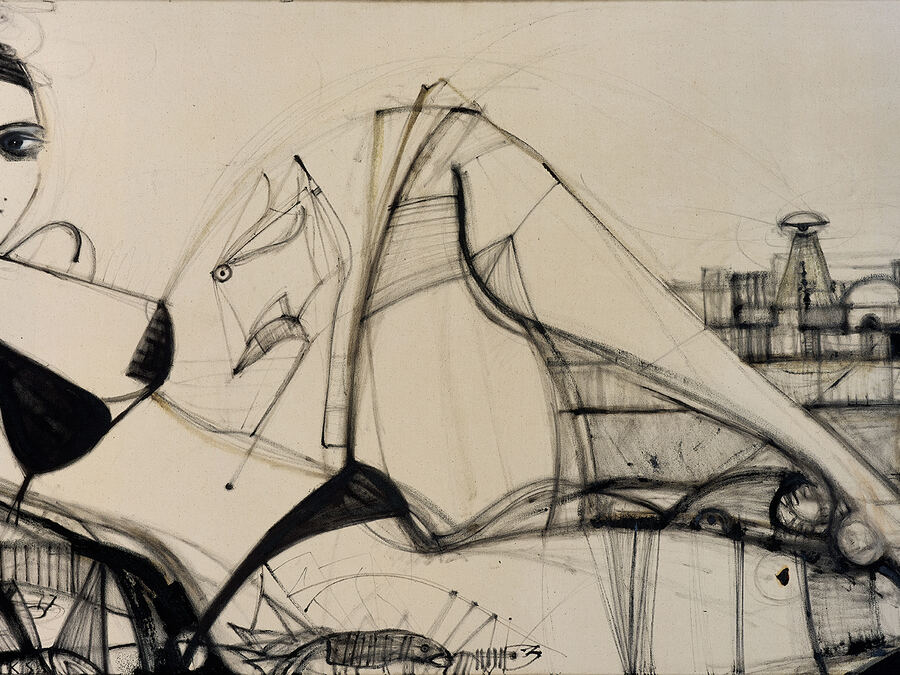
The abstract, up to and including the non-representational, gives the painter ample room to develop new forms and compositions, and by not being fixed, the pictures remain appealing. My pictures are attempts at association and facets, intended to stimulate the imagination.
Certain representational forms, on the other hand, leave little room for our own fantasies. Colours taken out of their natural context and put on the canvas in a new composition often take on a new meaning and brighten the otherwise so drab realism of a bare wall. The wall is, after all, what we look at every day.
“Arrivederci” refers to a picture that I have made the title of this exhibition. This small picture reflects the fleeting nature of the moment, what we piece together for ourselves as a reminiscence, in all its sweet distortion.
“Arrivederci” also means taking leave, again and again, of forms that have become too fixed, in order to engage with something new. Time watches over this law of change automatically and arbitrarily.