Tango Concert
Juri Tarasenok, Kleif Carnarius
21 May 2010
Let yourself be seduced this evening by a richly varied world of sound, from sultry tangos to soulful harmonies.
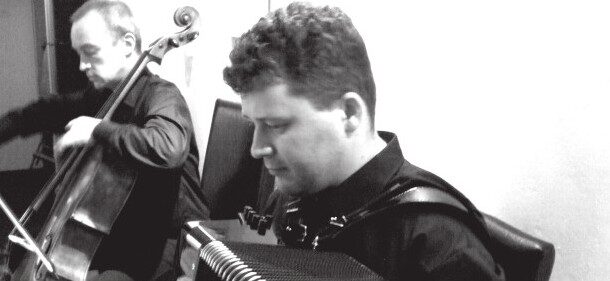
Embark on a journey full of contrasts with Juri Tarasenok on the bayan and Kleif Carnarius on the cello.
Juri Tarasenok was born in Kopyl, Belarus.
He attended the Duldurga music school and the Chita music college in Russia, as well as the Molodechno music college in Belarus. At the National Academy of Music in Minsk he studied the bayan (button accordion). From 1998 to 1999 he taught at the Kopyl music school. Further studies at the Hanns Eisler School of Music Berlin followed from 2002. He completed his studies in 2005 with the concert diploma (Konzertexamen), appearing as soloist with the Berliner Symphoniker in Ole Schmidt’s Symphonic Fantasy & Allegro, Op. 20.
Appearances:
2004 Deutsches Theater Berlin
“The Power of Habit” (“Macht der Gewohnheit”)
2004 Komische Oper Berlin, Alban Berg, “Wozzeck”
2005 as soloist with the Berliner Symphoniker, Ole Schmidt, Symphonic Fantasy & Allegro, Op. 20
2005 Stadttheater Aachen
“The Red Zora and Her Gang” (“Die Rote Zora und ihre Bande”)
2005, 2006, 2007, 2008 Komische Oper Berlin, Mozart, “The Marriage of Figaro” (“Hochzeit des Figaro”)
2006, 2007 Komische Oper Berlin, Handel, “Orest”
2006 Komische Oper Berlin
Moritz Eggert, “The Depth of Space” (“Die Tiefe des Raumes”)
2006, 2007, 2008 Komische Oper, Kurt Weill, “Rise and Fall of the City of Mahagonny” (“Aufstieg und Fall der Stadt Mahagonny”)
2005, 2006, 2007 Komische Oper Berlin
New Year’s Eve concerts
Since 2003, as a member of the band Apparatschik, he has given concerts in around 200 European cities, plus numerous solo appearances. Kleif Carnarius (cello) was born in Bad Frankenhausen in 1963 and received his first cello lessons at the age of five.
After attending the specialist music school in Weimar, he studied at the Franz Liszt University of Music there, under Lieselotte Pieper. After graduating, he took lessons with Professor Peter Vogler in Berlin.
From 1986 to 1989 he taught as an artistic assistant at the university in Weimar and was a member of the Nasdala Quartet, with which he gave concerts in Europe and Asia.
In 1989 he became principal cellist of the orchestra of the Komische Oper Berlin and was given a teaching post at the Hanns Eisler School of Music Berlin.
In the same year he became principal cellist of the Neues Berliner Kammerorchester, with which he went on concert tours across Europe in the following years and played on numerous CD recordings.
Alongside his commitments as principal cellist of the Komische Oper Berlin and as a lecturer at the Hanns Eisler School of Music Berlin, he gives concerts as a soloist and as a member of the Artenius Piano Trio, which he founded with Mika Yonezawa and Katia Tchemberdji.
The bayan is the Russian form of the chromatic button accordion. The word bayan comes from Russian and originally meant a poet-singer – what one would call a rhapsode in ancient Greece or a bard in the Celtic Middle Ages.
In 1870, N. I. Beloborodov in Tula developed a three-row chromatic accordion, which was, however, modelled entirely on the Schrammel accordion. The key layout, the number of buttons and the bass layout were identical. By 1872 the first bayan tutors had already been published in Russian. In 1883 P. I. Tchaikovsky visited Tula, after which he composed his Suite No. 2 in C major, Op. 53 (“Suite
caractéristique”). Four bayans were used in it for their tonal colour. Today there is a great deal of classical music written specifically for the bayan. In the former Soviet Union and today’s Russian Federation there have been, and still are, numerous composers who also use the bayan in the orchestra. Probably the most important composer for the bayan was Vladislav Zolotarev.