

As I engage in the so-called "bull sessions" around and about the school, I too often find that most college men have a misconception of the purpose of education. Most of the "brethren" think that education should equip them with the proper instruments of exploitation so that they can forever trample over the masses. Still others think that education should furnish them with noble ends rather than means to an end.
It seems to me that education has a two-fold function to perform in the life of man and in society: the one is utility and the other is culture. Education must enable a man to become more efficient, to achieve with increasing facility the ligitimate goals of his life.
Education must also train one for quick, resolute and effective thinking. To think incisively and to think for one's self is very difficult. We are prone to let our mental life become invaded by legions of half truths, prejudices, and propaganda. At this point, I often wonder whether or not education is fulfilling its purpose. A great majority of the so-called educated people do not think logically and scientifically. Even the press, the classroom, the platform, and the pulpit in many instances do not give us objective and unbiased truths. To save man from the morass of propaganda, in my opinion, is one of the chief aims of education. Education must enable one to sift and weigh evidence, to discern the true from the false, the real from the unreal, and the facts from the fiction.
The function of education, therefore, is to teach one to think intensively and to think critically. But education which stops with efficiency may prove the greatest menace to society. The most dangerous criminal may be the man gifted with reason, but with no morals.
The late Eugene Talmadge, in my opinion, possessed one of the better minds of Georgia, or even America. Moreover, he wore the Phi Beta Kappa key. By all measuring rods, Mr. Talmadge could think critically and intensively; yet he contends that I am an inferior being. Are those the types of men we call educated?
Work – Exhibit – Exchange
At the heart of the foundation’s activities lies the Artist in Residence program. Fellows are provided with living and studio space for a period of three to twelve months, opportunities to present their work in the foundation’s own exhibition spaces, and receive financial support through a residency grant. In addition, they become part of a vibrant and well-connected network of artists and cultural professionals.

The Starke Art Foundation supports young, emerging artists across all genres. In an inspiring yet exclusive environment, they are given the opportunity to fully focus on their artistic practice and to develop or refine their individual style. We assist them in their artistic growth and actively encourage dialogue and exchange among the resident artists.
Artists from both Germany and abroad are welcome to apply up to the age of 40. Applications are accepted year-round. An independent jury selects the artists who will be awarded a residency fellowship by Stiftung Starke.
In addition, guest apartments are available for short-term stays by established artists. Please note that energy costs during the residency must be covered by the fellows themselves.
All projects of the Starke Foundation are accompanied by international curators and supported through scholarly engagement.
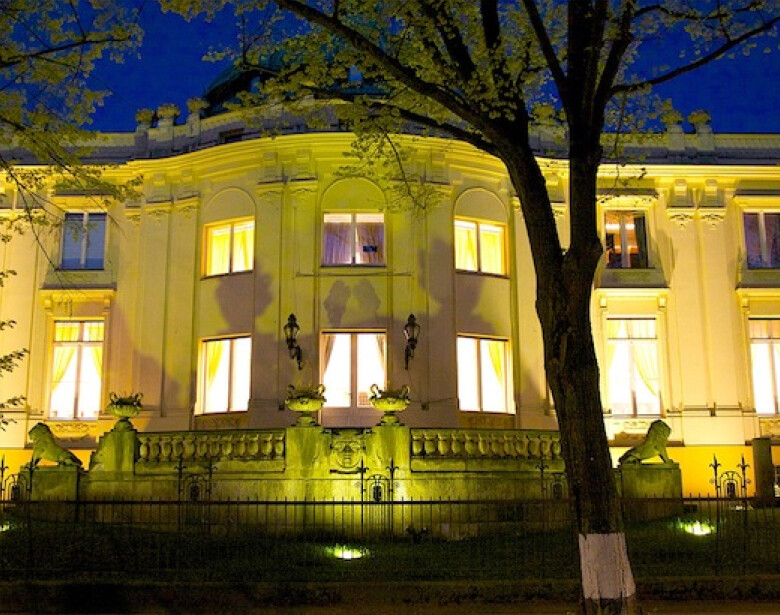
Das Löwenpalais, Sitz der Kunststiftung Starke, gehört zu den größten und prächtigsten Bauten in Berlin-Grunewald. Zwei steinerne Löwen, die die Fassade flankieren, gaben der Villa im neobarocken Stil ihren Namen.
Ansprechpartner für Vermietung des Löwenpalais
Myron Stülper - Eventmanagement
myron.stuelper@gmail.com
+49 176 32101618
+49 30 26039501
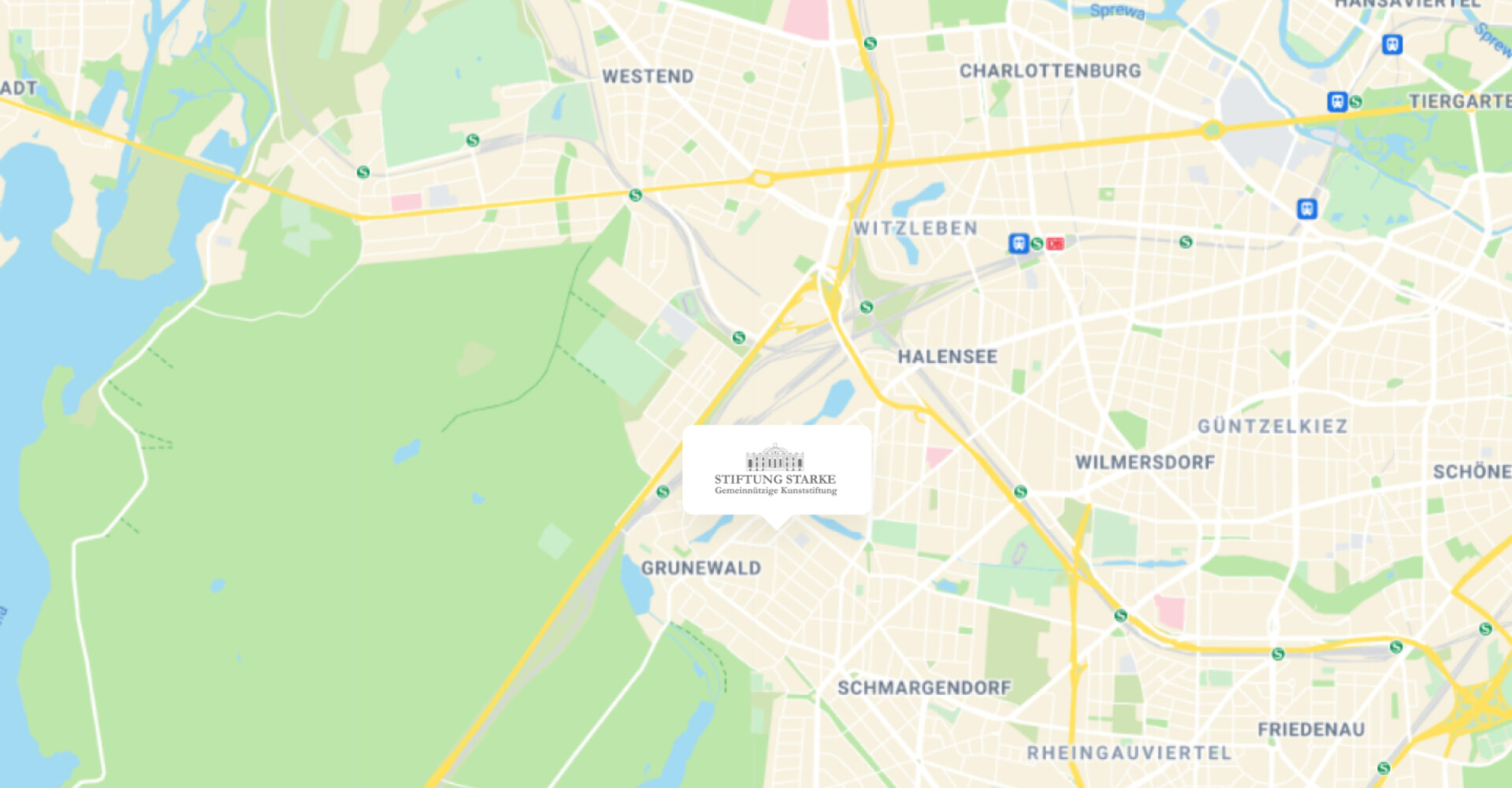
Peter Starke Non-Profit Foundation
Koenigsallee 30–32
14193 Berlin, Germany
Phone: +49 30 825 76 85
Fax: +49 30 825 87 34
Email: info@stiftungstarke.de
Website: www.stiftungstarke.de
The Peter Starke Non-Profit Foundation is a legally recognized foundation under civil law in accordance with German law.
Eligible applicants are artists up to and including the age of 38.
There is no financial grant. The studios are subsidized, which means that a contribution towards energy costs must be paid. This amount is based on the current market situation.
All artistic genres are supported: painting and sculpture, architecture and design, music and composition, performance, installation, conceptual art, as well as literature and new media.
Residency grants are awarded for a period of three to twelve months.
Fellows receive a residency grant. This includes free accommodation and studio space in the residence facilities, as well as the opportunity to present their work in a solo or group exhibition at the Löwenpalais, provided the artistic quality is sufficient.
To apply for a residency grant, the following documents must be submitted digitally in German or English:
Completed application form
Letter of motivation / Project description outlining the planned artistic work during the residency (max. 2 A4 pages)
Artistic CV
Formal documents (e.g., proof of residence, ID card, passport for non-EU applicants)
Financial plan: Applicants must provide documentation proving they are able to finance their stay at the Löwenpalais themselves.
Applications can be submitted on a rolling basis; there is no fixed deadline.
Residency grants are awarded by the Starke Art Foundation based on the decision of an independent jury. Applicants will be notified in writing. Decisions will not be justified.


Copyright © 2025 Stiftung Starke


 loewenpalais-events.de
 /loewenpalais
 /loewenpalais
